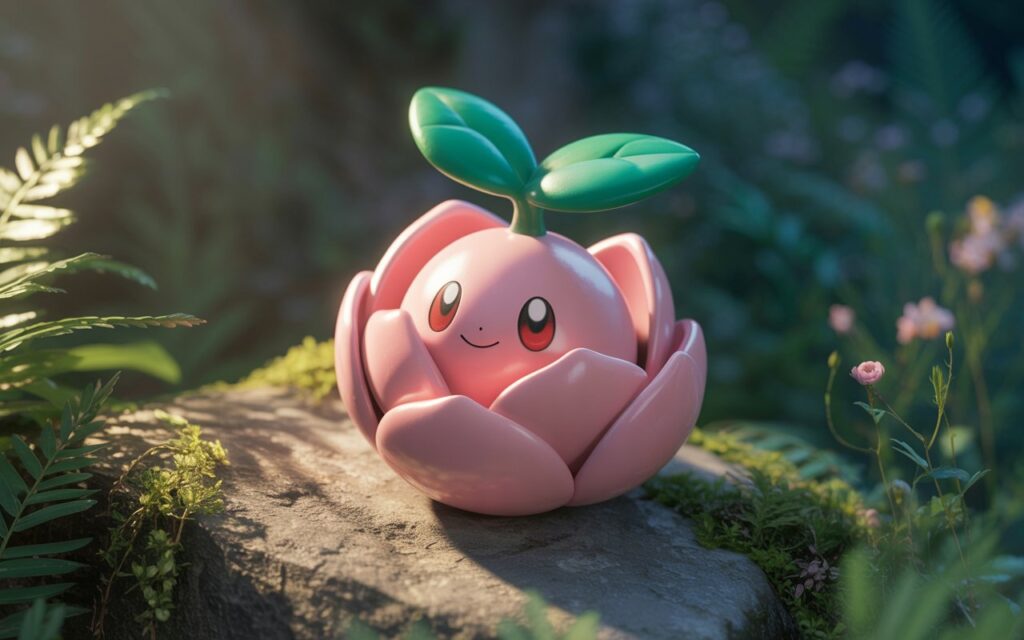
What does “Rosebud Pokémon” mean?
The name “Rosebud Pokémon” usually points to Budew, a small Grass and Poison type from Generation IV. Budew looks like a tiny rosebud that has not opened yet, which is why fans gave it this nickname. Some people also use the word for other flower Pokémon, but Budew is the closest match. I still remember when I first caught Budew in Pokémon Diamond and Pearl. Its little closed flower made it look simple, but it carried the promise of something bigger once it evolved.
Why the term sparks curiosity among fans
The word “rosebud” makes players curious because it hints at growth and hidden beauty. For older fans, it feels like a symbol—something small that can grow into Roselia and later Roserade. For new fans, it can be confusing since there is no official Pokémon named Rosebud in the Pokédex. I’ve seen players in online groups asking if Rosebud might be a secret Pokémon or if it’s just another name for Budew. That mix of mystery and fan talk keeps the idea alive in the community.
What Is a Rosebud Pokémon?
The idea of “Rosebud” as a Pokémon concept
The term “Rosebud Pokémon” is often used by fans to describe small flower Pokémon, especially Budew. Budew looks like a tiny rosebud before it blooms, which makes the name feel natural. You won’t find “Rosebud” in the official Pokédex, but the idea comes from how its design shows growth and new beginnings. When I first caught Budew in Pokémon Diamond, I thought of it as my little rosebud, waiting to open. Many players feel the same, which is why this nickname became popular.
Fan-created name versus official Pokémon
“Rosebud Pokémon” is a fan-made name, not an official one. In the real Pokédex, Budew is called the Bud Pokémon, and it evolves into Roselia and later Roserade. The word “rosebud” spread because fans wanted a simple way to describe Budew’s look and story. I’ve noticed this happens often in the Pokémon community—players create their own terms, and sometimes those names feel just as real as the official ones. This is part of what makes Pokémon fun: it’s shaped by both the creators and the fans who love it.
Origins & Inspiration
Cultural and Design Inspiration—Roses and Their Symbolism
Roses are known all over the world as a symbol of love, beauty, and even mystery. This makes them a perfect idea for Pokémon designs. The Budew line shows this clearly—a small rosebud that grows and changes with time, just like real flowers. When I first raised a Budew in Pokémon Diamond, I felt like it was more than just training a Pokémon. It reminded me of how flowers need care, sunlight, and patience before they bloom.
Notable Flower-Themed Pokémon Embodying “Rosebud” Vibes
Budew, Roselia, and Roserade are the main rose-inspired Pokémon, but they’re not the only ones. Other flower Pokémon like Flabébé, Floette, Florges, and Lilligant also carry that same garden feel. Each of them has designs that show beauty, growth, and nature’s power. I always liked using Roserade in battles—it looks delicate but can hit hard, which makes it both elegant and dangerous. These Pokémon show that the “rosebud” idea is more than a fan term—it’s part of how the series connects flowers with strength and style.
The Budew Evolutionary Line (The Closest Fit to “Rosebud”)
Overview: Budew → Roselia → Roserade
The closest Pokémon to a real Rosebud Pokémon is the Budew line. Budew begins as a tiny closed bud, then grows into Roselia, and finally blooms into Roserade. This line is part of the Grass/Poison type family, which gives it strong plant moves but also some clear weaknesses. When I raised a Budew in Pokémon Diamond, I enjoyed seeing it slowly change. It felt like watching a small plant I cared for grow into something beautiful and powerful.
Budew’s Species Data: Type, Abilities, Evolution Method
The Pokédex lists Budew as a Grass/Poison-type Pokémon. It is very small, only about 8 inches tall and weighing just 2.6 pounds. Budew’s abilities include Natural Cure (heals status problems when it switches out) and Poison Point (can poison an enemy that makes contact). Its hidden ability, Leaf Guard, protects it from status effects in sunny weather. Budew may look weak at first, but with the right care, it can turn into a very strong Pokémon.
Evolution Mechanics: Friendship and Shiny Stone
Budew does not evolve by leveling up alone. To become Roselia, it needs high friendship with its Trainer and must level up during the daytime. Friendship grows when you walk with it, battle, or give it items it likes. After it evolves into Roselia, you can use a Shiny Stone to make it change into Roserade. When I trained my first Budew, I kept checking each morning to see if it was ready. The moment it finally evolved felt rewarding because I had worked to build that bond.
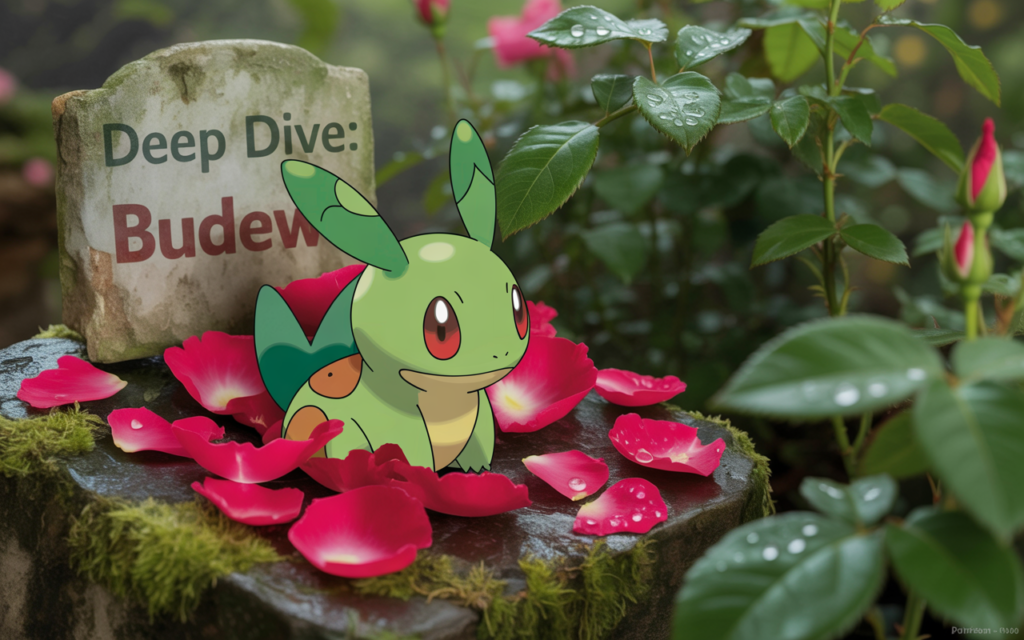
Deep Dive: Budew
Appearance & Biology
Budew is a small rosebud-like Pokémon that looks like a tiny plant ready to bloom. Its body is green, and its round yellow face makes it look gentle and curious. It has two little leaves that wrap around its unopened bud, almost like it is keeping a secret inside. When I first saw Budew, it reminded me of real rosebuds I’ve seen in gardens, staying closed until the right time to open. This design makes Budew easy to recognize and very memorable in the Pokémon world.
Behavior and Seasonal Traits
Budew changes its behavior with the seasons. During winter, its bud stays shut tight to protect itself from the cold. In spring, the bud begins to open, and that’s when Budew starts to spread pollen. This feels very natural, just like flowers in real life that wait for warm weather before blooming. I remember playing Pokémon Diamond and Pearl and noticing this detail—it made Budew feel more alive, almost like a real plant living in its own cycle.
Toxic Pollen and Environmental Role
Even though Budew looks cute, its pollen can be toxic. The powder it releases can make people and Pokémon sneeze or feel sick if they get too close. Budew usually lives near ponds or grassy fields, where it can stay safe and hidden. The pollen works as a shield, keeping away enemies while Budew grows. In my own playthroughs, I liked how this small Pokémon used nature itself to protect against danger—it showed me that size doesn’t always decide strength.
Roselia: The Blossoming Intermediate
Design Evolution from Budew to Roselia
Roselia is the next step in the Budew line. Budew looks like a tiny seed, but Roselia opens up into a pretty flower with two rose arms—one red and one blue. This shows both beauty and danger because Roselia is lovely but also poisonous. I’ve always liked how the game makes Roselia feel like a flower that finally blooms after waiting. It makes the evolution feel natural and exciting.
Moveset and Battle Role
Roselia works best as a support Pokémon. It can use status moves like Stun Spore and Toxic Spikes to slow down or weaken the other team. When I played Pokémon Emerald, I used Roselia in the Battle Tower. It wasn’t my strongest attacker, but setting up Toxic Spikes gave my team an advantage. If you like strategy instead of just power, Roselia is a smart and useful choice.
Roserade: The Full Bloom Final Stage
Aesthetic evolution and competitive strength
Roserade is the final form of Budew and Roselia. It looks like a dancer holding roses, but those flowers hide poison. In battles, Roserade is a fast Grass/Poison attacker with high Special Attack. When I used it in Pokémon Go, I loved how strong it felt while still looking stylish on the field.
Signature moves and strategies in battle
Roserade can use moves like Sludge Bomb, Energy Ball, and Toxic Spikes. Toxic Spikes are great for slowing down the other team because they poison Pokémon when they switch in. I once used this move in a match, and my opponent had to keep changing Pokémon to stay safe. Roserade is not very tough, so you need to play smart, but it can control a battle if used right.
Battle Strengths & Weaknesses of the Rosebud Line
Type advantages and resistances
The Budew family is Grass and Poison type. This makes them strong against Water, Electric, Grass, and Fairy Pokémon. But they are weak to Fire, Psychic, Flying, and Ice moves. I remember sending Roselia against a Fire-type once, and it fainted almost instantly. Planning your matchups is very important with this line.
Ideal moves and strategies in battle
Roserade is best when used for quick, heavy damage. Leaf Storm or Sludge Bomb can hit hard and take down bulky Water or Fairy Pokémon. For a different style, you can use moves like Toxic Spikes or Stun Spore to weaken enemies. I like to mix both styles—setting hazards while keeping at least one strong attack ready. It makes Roserade useful in many situations.
Rosebud-Themed Pokémon Beyond the Budew Line
Fairy-type floral Pokémon: Flabébé, Floette, Florges
Other flower Pokémon also feel like part of the rosebud theme. Flabébé, Floette, and Florges are Fairy-types that show the beauty of flowers at different stages. They look soft and magical, unlike Roselia’s more toxic design. I caught a shiny Flabébé once in Pokémon Go, and it instantly became one of my favorites.
Graceful Grass-type blooms: Lilligant
Lilligant is another flower Pokémon known for its flower crown and elegant style. It is different from Roserade because it focuses more on grace than poison. In battles, it uses Quiver Dance to boost its stats and can sweep teams if not stopped. I’ve seen Lilligant surprise whole teams with this move, which makes it a hidden powerhouse.
Sun-flower motif: Sunflora
Sunflora is the cheerful sunflower Pokémon. It may not be very strong, but its design is bright and full of energy. I once raised a Sunflora in Pokémon HeartGold. Even though it fainted often, it always made me smile. Sunflora shows that flower Pokémon can bring joy, not just power.
Community Buzz & Pop Culture Influence
NYT Connections game and “Ketchum–Rosebud–Primate” link
The name “Rosebud Pokémon” became popular after it showed up in the New York Times Connections game. Players had to connect words like Ketchum, Rosebud, and Primate. Many fans thought right away about Pokémon. I remember seeing it online that day, and even people who don’t play asked me what it meant.
Fan lore, memes, and how “Rosebud Pokémon” trends
Fans love to make memes and new stories. Some made fake Pokémon cards with Rosebud, while others drew it as a mix of Budew and Caterpie. I once joined a Pokémon forum where people shared their own designs, and it felt just like this trend. These fan ideas show how much the community enjoys creating.
Fan Interpretations: Abilities & Lore
Speculative abilities of fan-made “Rosebud” Pokémon
Because Rosebud is not real in the games, fans imagine what powers it could have. Some say it should have Overgrow, a common Grass-type ability. Others think it could use Shield Dust, since it looks like a bug in some fan art. I even saw fan stats that gave Rosebud strong Defense but weak Speed.
Common fan theories and creative lore extensions
Fans also like to build stories around Rosebud. One idea is that it only evolves in spring when the sun is bright. Another says it spreads soft pollen that calms people and Pokémon. I used to draw my own Pokémon with stories like this, so I know how fun it is to imagine. These theories keep Rosebud alive in the fan world.
Catching the “Rosebud Pokémon”
In-game evolution: Budew in main series and Pokémon GO
Rosebud does not exist, but Budew is the closest Pokémon to it. In the main games, Budew evolves into Roselia when it has high friendship during the day. Later, Roselia evolves into Roserade with a Shiny Stone. In Pokémon GO, Budew often shows up during spring events. I remember hatching my first Budew from an egg, and I was excited when I saw it had strong stats.
Spoofing tools (like location changers) for thematic Pokémon events
Some players use apps like iMyFone or MagFone to change their GPS and join Pokémon GO events. These tools help them catch Pokémon that are rare in their country. I prefer playing fair, but I know many people try spoofing to get Pokémon like Budew faster. Guides warn that spoofing can be risky, so players need to be careful.
Trivia & Fun Facts
Notable tidbits (e.g., shortest Grass-type, name origin)
Budew is one of the shortest Grass-type Pokémon, only 0.2 meters tall. Its Japanese name, Subomii, means “bud,” which fits the rosebud idea. When I first caught Budew in Pokémon Diamond, I was surprised to learn it was so tiny.
Pop culture nods, such as Inn name and logo based on Budew
In the Galar region games, there is a Budew Drop Inn with a logo of Budew. It shows how even small Pokémon can be part of the world’s culture. I always liked these little details because they make the Pokémon world feel real.
Conclusion
Summarizing why the “Rosebud” concept resonates
The “Rosebud Pokémon” idea is popular because it stands for growth and mystery. A flower bud is a sign of something about to bloom, and that matches how players see Pokémon—always growing and changing. Even though Rosebud is not official, the idea excites fans.
Fan creativity versus official canon
Rosebud also shows how much fun fans have making their own ideas. The games give us Budew, Roselia, and Roserade, but fans added Rosebud to the story. Pokémon is not only about what’s in the Pokédex—it’s also about the creative world fans build together.
FAQS
Is there an official Rosebud Pokémon?
No, there is no real Pokémon named Rosebud. Fans use this name because Budew and its evolutions, Roselia and Roserade, look like roses. When I first saw people talk about it, I thought it was a secret Pokémon too! Later, I checked trusted sites like Pokémon Wiki and iMyFone, and I learned it’s just a fan nickname, not an official one.
How do you evolve Budew into Roselia?
Budew turns into Roselia when it has high friendship with you and levels up in the daytime. You can raise friendship by walking with it, battling without letting it faint, and giving it berries. I remember in Pokémon Platinum, I kept Budew in my team for weeks. One morning it finally evolved, and it felt great because I worked hard for it. For step-by-step info, Pokémon Database and Pokémon Wiki are super helpful.
How to evolve Roselia into Roserade?
Roselia evolves into Roserade when you use a Shiny Stone. This one is much easier than Budew’s evolution because you don’t need friendship or daytime. In my own play, I always saved my Shiny Stone for Roselia, since Roserade is strong and stylish. If you don’t know where to find the stone, check Pokémon Wiki or Pokémon Database for clear guides.