Understanding how time is structured helps us organize our lives better. One of the most common questions people ask is how many weeks exist within a single year. While the quick answer seems simple, the actual explanation involves basic math, calendar systems, and natural cycles. In this article, we will break down everything in a clear and professional way. By the end, you will not only know the answer but also understand the reasoning behind it in a practical and easy-to-follow manner.
Exact Answer – How Many Weeks Are in a Year?
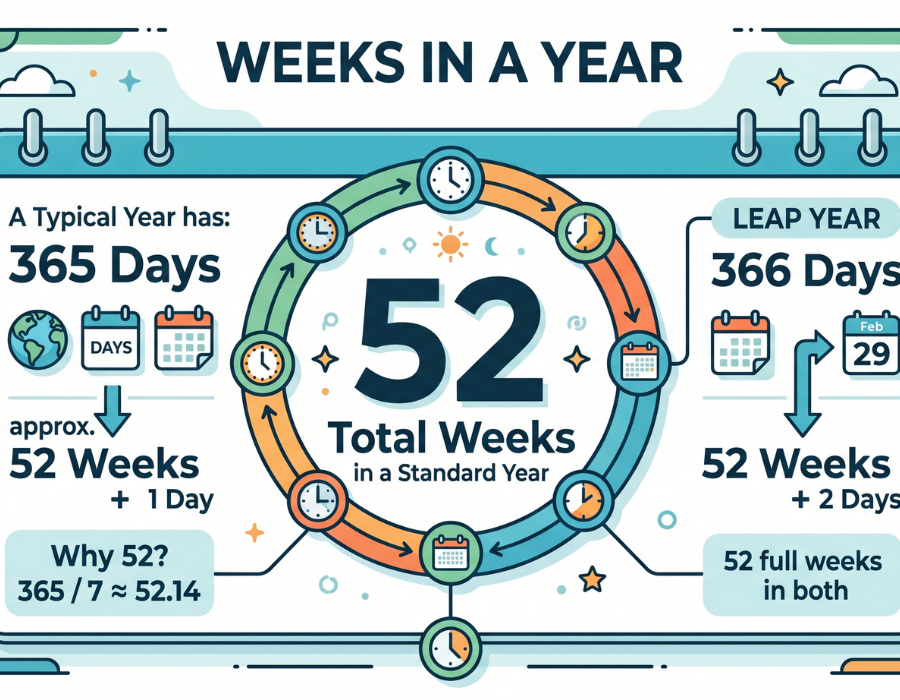
A standard calendar year contains 365 days, and since each week consists of 7 days, dividing 365 by 7 gives approximately 52.14 weeks. This means there are 52 complete weeks and one extra day remaining. That additional day plays a role in shifting calendar dates each year. While people commonly refer to a year as having 52 weeks, the precise calculation shows it is slightly more than that, making it important to consider the leftover day for accuracy.
How Many Weeks in a Leap Year?
A leap year occurs every four years and includes 366 days instead of the usual 365. When divided by 7, this results in 52 weeks and 2 extra days. The additional day is added to February, making it 29 days long. This system ensures that our calendar remains aligned with Earth’s orbit around the sun. Without leap years, seasonal events would gradually shift, causing long-term inaccuracies in how we measure and organize time throughout the year.
Why Does a Year Have 52 Weeks (Not 48 or 56)?
The confusion about weeks often arises from the assumption that each month contains exactly four weeks. While 4 weeks equal 28 days, most months actually have 30 or 31 days, which adds extra days over time. When these additional days accumulate across all 12 months, they result in a total closer to 52 weeks rather than 48. This explains why a year cannot be simplified into equal four-week segments and highlights the importance of understanding calendar structure.
How to Calculate Weeks in a Year (Step-by-Step)
Calculating the number of weeks in a year is a straightforward process. First, identify the total number of days in the year, which is 365 for a regular year and 366 for a leap year. Next, divide that number by 7, the number of days in a week. The result will give you the number of full weeks plus any remaining days. This simple calculation helps students and professionals accurately understand time divisions without relying on memorization.
Are There Ever 53 Weeks in a Year?
In certain cases, a year may be considered to have 53 weeks, depending on the calendar system used. The ISO week date system, commonly used in business and international planning, defines weeks differently. If a year begins on a Thursday or is a leap year starting on a Wednesday, it can contain 53 full weeks. However, this does not change the total number of days; it simply reflects how weeks are grouped within that specific system.
How Many Weeks in a Year by Calendar Type
Different calendar systems can influence how weeks are counted within a year. The Gregorian calendar, which is widely used worldwide, follows the standard 365 or 366-day structure. In this system, a year always includes 52 weeks plus extra days. On the other hand, the ISO week calendar organizes time based on full weeks, sometimes resulting in 53-week years. Understanding these systems is useful for global coordination, especially in business and academic environments.
How Many Working Weeks in a Year?
While a year contains about 52 weeks, not all of them are used for work. When weekends, public holidays, and vacation days are subtracted, the number of working weeks typically falls between 48 and 50. This estimate can vary depending on location, industry, and individual schedules. Understanding working weeks is essential for planning projects, setting goals, and managing productivity effectively throughout the year in both professional and personal contexts.
Weeks vs Months – Simple Breakdown
Many people assume that each month consists of exactly four weeks, but this is not accurate. A month typically contains about 4.3 weeks on average. Since most months have more than 28 days, the extra days accumulate over the year, increasing the total number of weeks beyond 48. This distinction is important when converting between months and weeks, particularly in planning, budgeting, and scheduling tasks that require precise time management.
Quick Comparison Table – Year Types
To better understand the difference between year types, it is helpful to compare them directly. A normal year contains 365 days, which equals 52 weeks and 1 extra day. A leap year contains 366 days, resulting in 52 weeks and 2 extra days. This comparison highlights how small changes in the number of days can affect the weekly structure. Such clarity is valuable for both educational purposes and practical time planning.
Why Extra Days Matter in the Calendar
The extra one or two days in a year may seem insignificant, but they play a crucial role in maintaining calendar accuracy. Without these additional days, dates would gradually shift over time, causing seasons and events to misalign. For example, summer could eventually occur during what we consider winter. These extra days act as a correction mechanism, ensuring that our calendar stays synchronized with Earth’s natural cycles and astronomical movements.
Real-Life Uses of Knowing Weeks in a Year
Understanding how many weeks are in a year has practical applications in everyday life. It helps individuals plan long-term goals, manage finances, and organize schedules more effectively. For example, breaking a yearly goal into weekly targets makes it easier to track progress and stay motivated. Businesses also rely on weekly calculations for budgeting, reporting, and workforce planning. This knowledge provides a structured approach to managing time efficiently.
Common Misconceptions About Weeks in a Year
There are several common misunderstandings regarding weeks in a year. One major misconception is that a year contains exactly 52 weeks, ignoring the extra days. Another is the belief that every month has four weeks, which leads to incorrect calculations. Additionally, some assume all years are identical, overlooking the impact of leap years. Clarifying these misconceptions helps individuals gain a more accurate understanding of how time is structured and measured.
Conclusion
In summary, a year contains approximately 52 weeks, but the precise calculation includes one or two extra days depending on whether it is a regular or leap year. This small difference is essential for maintaining calendar accuracy and aligning with natural cycles. By understanding how weeks, days, and months interact, individuals can better manage their time and make informed decisions in both personal and professional life. This knowledge, though simple, plays a significant role in effective planning.
FAQs
How many weeks are there in a normal year?
A normal year contains 52 full weeks and 1 extra day, making it slightly more than exactly 52 weeks.
How many weeks are in a leap year?
A leap year includes 52 weeks and 2 extra days due to having 366 days instead of 365.
Why doesn’t a year have exactly 52 weeks?
Because 365 days cannot be divided evenly by 7, leaving extra days after calculating full weeks.
Can a year have 53 weeks?
Yes, in systems like the ISO calendar, certain years can include 53 full weeks based on how days align.
How many weeks are in 365 days?
There are approximately 52.14 weeks in 365 days, which equals 52 weeks and 1 remaining day.